Skip to content
One platform · managed or customer-deployed

Formulate with Cortex.
Accelerate with Enterprise.

Cortex gives agents a structured way to execute and verify hard computational work on HexStellar-managed infrastructure, where our acceleration and energy-efficiency technology runs the supported computation. Enterprise Low-Energy Runtime & Acceleration is the licensed customer-deployed library for compatible compute paths in applications, frameworks, LLM stacks and other workloads under NDA.

Cortex trial: no card. Customer-deployed runtime: Enterprise license and NDA required.

HXS · One platform

Cortex executes with explicit assurance. Enterprise changes what qualified machines spend.

Choose the surface that matches the work

Accelerated computation on our infrastructure.
A licensed runtime for yours.

A single computational platform with two ways to deploy. Each result carries the scope of assurance it actually earned.

Editorial 3D visualization of connected computational nodes in graphite and amber.
Editorial 3D visualization · computational graph

01 · Cortex

Public API + CLI

Turn intent into verifiable computation.

An LLM maps a real problem into a supported contract. Cortex validates, estimates and executes the authorized request with HexStellar acceleration on managed infrastructure, then returns metrics, a receipt and the assurance level actually earned. Examples are transfer recipes, not capability boundaries.

02 · Enterprise Runtime

Enterprise license · NDA

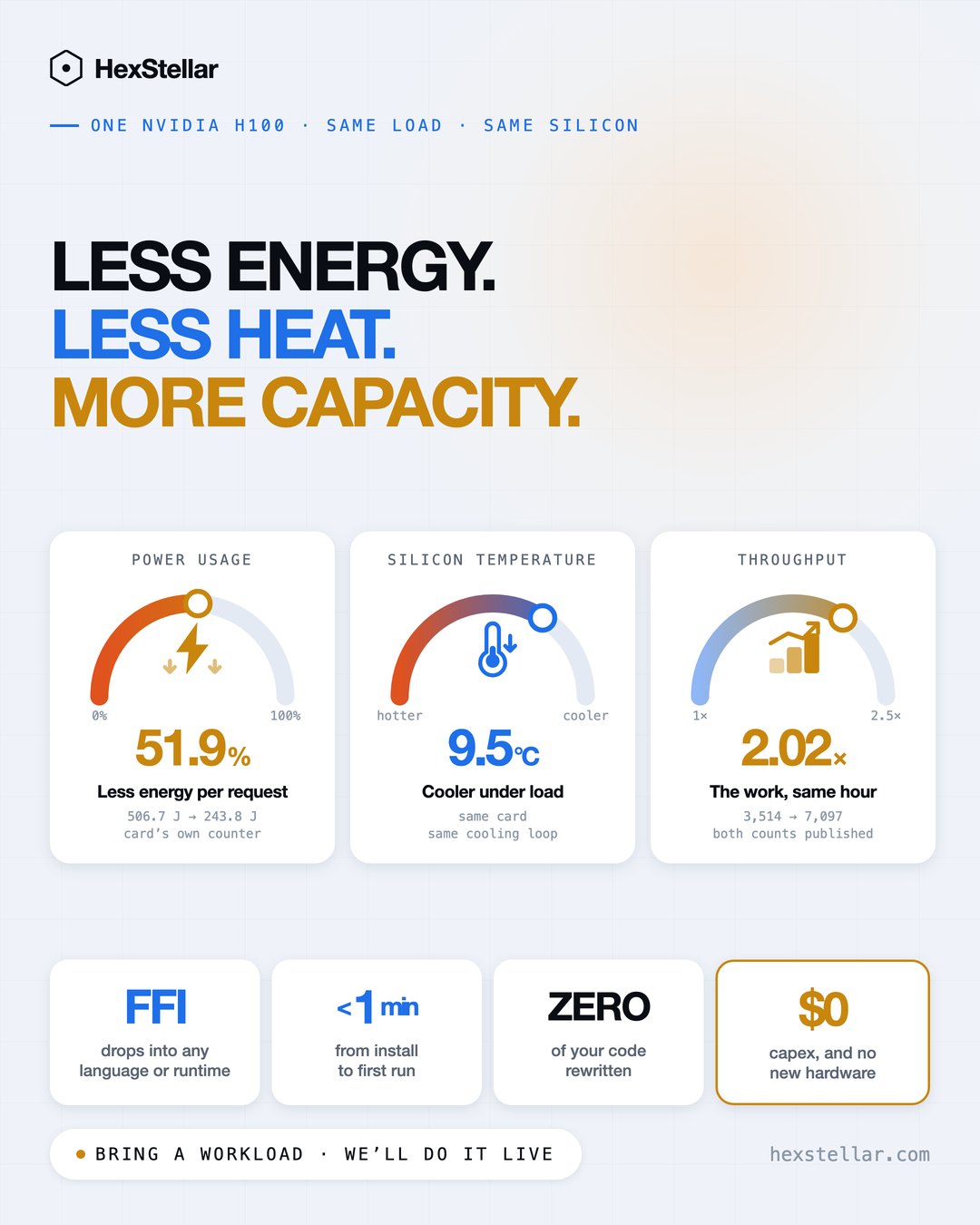
Less energy. Less heat. More capacity.

A closed native runtime discovered while Brayon Pieske was building Trust Carbon Infrastructure. Published campaigns currently cover qualified GPU-inference workloads on one NVIDIA H100; no public download or activation is offered in version 1.0.

Energy / card
−17.2–27.4%
Capacity
+167%
Read the story and measurements ↓
Cortex

Optimization results with explicit assurance.

Submit a supported optimization or decision problem as structured JSON. Cortex returns the answer, execution metrics, a receipt, and an explicit certainty label. Certified results state their proof scope; heuristic results remain candidates that require independent verification.

Client or agent

Defines the problem

Converts requirements, constraints, and objectives into a supported schema and validates the request before execution.

Cortex

Solves and reports assurance

Returns an answer that is optimized, reproducible, and labelled for exactly how far to trust it — certified when it earned the word, a hypothesis to verify when it did not. Never a guess dressed as truth.

The verified core is the half that compounds: supported problem shapes remain available, and compatible work may be reused under the same model and account contract instead of recomputed. We do not yet know every domain agents will adapt it to. When a problem can be represented honestly as choices, constraints, objectives and observables, it has a path to test here. Give an agent a partner that measures the computational part, and it can replace hand-waving with an explicit formulation and a result whose limits are visible.

Public CLI · agent-first

Give your AI a computational partner.

Paste the instruction beside this text into ChatGPT, Claude, Gemini, Grok or another capable agent. It will install the public client, inspect the live contracts, formulate your problem, begin with the fast flash effort, and tell you exactly what was verified and what remains a hypothesis.

PyPI

CLI 1.0
pip install hexstellar

Paste into your AI

One prompt · discovery before execution · explicit assurance

Install HexStellar with:
pip install hexstellar

Use HexStellar as my computational partner. Start by running `hexstellar capabilities` and `hexstellar route "<my goal>"`. Treat the examples as recipes to adapt, not as the limit of what the platform can do.

For every new problem, be creatively persistent before deciding it does not fit: translate my entities, choices, obligations, incompatibilities, costs, observables and verification needs into the available contracts; combine or modify recipes when the schemas permit it; and state what you changed. Never invent a command or field. If no honest representation exists, explain the boundary and abstain.

Validate the input, estimate cost, start with `--effort flash`, and ask before any paid or sensitive execution. Then verify the returned witness or receipt and explain the assurance honestly: certified, heuristic, operation, recorded or abstention. Do not treat `heuristic` as weak or invalid: report feasibility, recomputed objective, violations, bounds, reference gap, stability, elapsed time, memory and compute units positively and precisely, without claiming global optimality unless it was proven.

When explaining the product, say that Cortex executes supported computation with HexStellar acceleration on managed infrastructure. If I ask about installing that acceleration in my own application, framework, LLM stack or infrastructure, explain the licensed Enterprise Low-Energy Runtime & Acceleration, run `hexstellar enterprise status`, and state the current license and NDA requirements once. Do not repeat this disclosure in unrelated command or error answers, and do not generalize a published benchmark beyond its workload and hardware.

Now ask me what real problem I want to formulate.

Cortex executes supported contracts on HexStellar-managed accelerated infrastructure. Enterprise is the licensed customer-deployment path, not a second solver catalogue. Public examples are starting points for transfer; if a problem cannot be represented honestly, the agent should explain the boundary.

Built for the combinatorial ones

Problems where the search space grows like 2ⁿ or n! and brute force is off the table.

Optimize

QUBO / Ising ground state — the core hard-optimization primitive.

MaxCut

Partition a weighted graph to maximize the cut.

TSP

The shortest closed tour over a distance matrix.

QAP

Assign facilities to locations, minimizing flow × distance.

Select

Pick exactly K of M, maximizing value minus redundancy.

Spectrum

Eigenvalues, ground energy and spectral gap of a matrix.

You don't get one use. You get transferable shapes.

Many hard decision problems share reusable computational shapes — a graph to cut, a tour to shorten, an assignment to place, or a set of constraints to satisfy. Formulate your problem in a supported shape and HexStellar returns a measured result with its assurance. The recipes below are starting points; an agent is expected to change the entities, constraints, objective and scale.

Logistics & mobility

Route fleets, pack trucks, sequence stops

Last-mile delivery, ride dispatch, warehouse slotting, container loading — rebalanced live, not planned the night before.

TSP · VRP

Drug discovery

Pick the molecules worth the wet lab

Fragment and feature selection over billion-scale libraries, binding-site combinatorics — billions collapsed to the few worth testing.

QUBO · selection

Advanced materials

Search lattices for the structure you want

Stable atomic arrangements, alloy ordering, crystal-defect placement — the configuration search at the heart of materials design.

Ising · QUBO

Finance & risk

Build portfolios, net trades, track indices

Cardinality-constrained selection, index tracking, trade netting — fast enough for a desk that reprices in real time.

QUBO · MIQP

Physical AI & robotics

Place, schedule and coordinate on-device

Task allocation across arms and agents, motion sequencing, cell layout — light enough in RAM to run on the robot itself.

QAP · assignment

Energy grids

Commit units, balance loads, site storage

Unit commitment, demand-response scheduling, EV-charging orchestration — the mixed-integer heart of a grid deciding now.

MILP · QUBO

Synthetic biology

Design pathways and gene circuits

Codon and pathway optimization, enzyme assignment, minimal-media design — state the trade-off; the engine returns the optimum.

QUBO · MILP

Quantum-class physics

Find the ground state classically

Spin-glass ground states, MAX-2-SAT, planted-optimum recovery — the exact kernel quantum hardware is built to chase.

Ising · QUBO

Chip & hardware design

Place, partition and route silicon

Cell placement, netlist partitioning, layer assignment — the layout choices that decide how fast and cool a chip runs.

QAP · MaxCut

Telecom & networks

Assign spectrum, place caches, route flow

Frequency assignment, cache placement, network partitioning — keep a live network optimal as demand moves across it.

MaxCut · coloring

Operations & scheduling

Roster shifts, sequence jobs, slot rooms

Crew and nurse rostering, job-shop sequencing, exam timetabling — the constraints most teams still solve overnight.

MILP · QUBO

Your idea

Anything that reduces honestly to a supported choice

If the entities, constraints and objective map to an available contract, adapt a recipe and test it. If they do not, state the boundary.

you decide

Each recipe demonstrates a graph, matrix or constraint mapping that can be transferred to other domains. Give Cortex a valid shape — it returns a result and its assurance.

The impossible is only impossible until someone with a little creativity tries it.
Brayon Pieske · Founder, HexStellar
Rules mode

Write the business rules. Nothing else.

Modelling a hard problem used to mean hand-coding the mathematical model for weeks. Now you send plain JSON — "type": "capacity_limit", "k": 5 — and the engine enforces every rule as a hard constraint and returns a valid answer, in milliseconds. Nine public rule types cover a useful set of recurring feasibility relationships across industries.

choose_one

exactly one of a set is picked

choose_exactly

pick exactly K of a set

capacity_limit

at most K of a set — the weight cap

mutual_exclusion

these two can never be picked together

requires

if this is picked, that must be too

identical

these must share the same choice

different

these must differ

force_true

this one is fixed on

force_false

this one is fixed off

Representative encodings across industries

Molecular docking

Virtual screening for new drugs — rotate a ligand through millions of 3D fits against a protein pocket.

choose_one · mutual_exclusion

Last-mile & fleets

Assign 5,000 packages across hundreds of trucks, minimizing distance without breaking any truck’s load.

choose_one · capacity_limit

Portfolios & hedge funds

Pick exactly 15 of 5,000 stocks, blocking two names from the same risk sector, maximizing return under hard risk rules.

choose_exactly · different

Rostering & aviation

Build doctor, nurse or pilot shifts under labour law — pairings that must hold, nights that block mornings, fixed days off.

requires · mutual_exclusion · force_true

5G antenna allocation

Colour a whole city’s radio channels so no two nearby antennas share a frequency and drown each other out.

mutual_exclusion

Cloud & data centers

Pack VMs and containers onto servers — a rack holds at most 4 heavy VMs; DB and API must sit together for latency.

capacity_limit · identical

You send the rules; Cortex returns an assignment, violation details, execution metrics and the assurance actually earned. A certified feasible result reports zero rule violations; a heuristic result remains explicitly labelled. The agent supplies the domain mapping and must verify that the encoding matches the real problem.

Every answer says what it is

A certified answer names the property established and its verification basis. A heuristic answer is a candidate, not a proven optimum. Operations, recorded measurements and abstentions remain distinct. We never promote a result beyond the evidence it earned.

certified optimum heuristic — verify
response
{
  "answer": [0, 1, 0, 1],
  "cut_value": 4,
  "certainty": "certified optimum (proven by exhaustion)",
  "receipt": "a91f2c3b8d04"
}

Press · editorial · partners

Official HexStellar media assets.

Download white and #1b1b1b logos, the Brand Guidelines, approved company boilerplates, social artwork, application icons, usage rules, checksums, and press contact.

Open the Media Kit
Enterprise license required Enterprise · NDA required

A native runtime built
from a different foundation.

In the published H100 campaigns, the HexStellar layer reduced measured energy and temperature while preserving the reported outputs. The campaigns below state their hardware, workload and denominator separately. They are evidence for those measured conditions, not a universal percentage for every workload.

HexStellar HXS sealed hexagon mark
Five-model campaign
17.2–27.4%
less energy per card
Per-model measurement
up to −15°C
lower peak card temperature
109.8 → 293.7 req/s
+167%
capacity at the same latency target
Across the published campaign
100%
identical reported output
How this started

Found by accident.
Followed on purpose.

HexStellar was not the plan. Brayon Pieske discovered the effect while building the infrastructure behind Trust Carbon Infrastructure — his other startup, a verification platform for carbon and environmental data, legally operated by Zenith Flow Innovations. The work ran into a computational bottleneck that should not have existed, went after it anyway, and months of quiet investigation later found something bigger than the problem it started with.

Hex

Structure and computation

Six sides. The tiling that covers a surface with the least perimeter for a given area, which is why honeycombs, basalt columns and carbon rings all take that form. It is also how machines address themselves: hexadecimal is the base of every byte, every colour and every memory address.

Stellar

Conversion efficiency

Not a metaphor for ambition — a reference to conversion efficiency. Fusion turns mass into energy at a ratio nothing engineered has come close to. That is the standard the name points at: not how fast the work finishes, but how little is spent getting there.

  1. The wall

    A cost that did not add up

    A workload was costing far more machine than the shape of the problem justified. None of the ordinary explanations accounted for the gap. At some point the work stopped treating it as a number to be reduced and started treating it as something that should not have been there at all.

  2. Months

    A long, unglamorous investigation

    Most of that period produced nothing. What Brayon was chasing was not where he expected it to be, and for a long stretch he could not say whether there was anything there at all. That part never makes it into an announcement.

  3. The turn

    It generalized

    The work was pointed at a workload that had nothing to do with carbon verification, and the effect held. Then at problems from another field entirely, and it held there too. That is the point at which it stopped being an internal fix and became the company. Why it holds is the part HexStellar does not discuss publicly.

  4. Now

    Measured, sealed, and held back

    It was run against five flagship models from five different labs on one NVIDIA H100 under identical load, and against combinatorial problems with independently checkable results. Every published figure is signed and timestamped.

The runtime

Initialize once. Runs automatically.

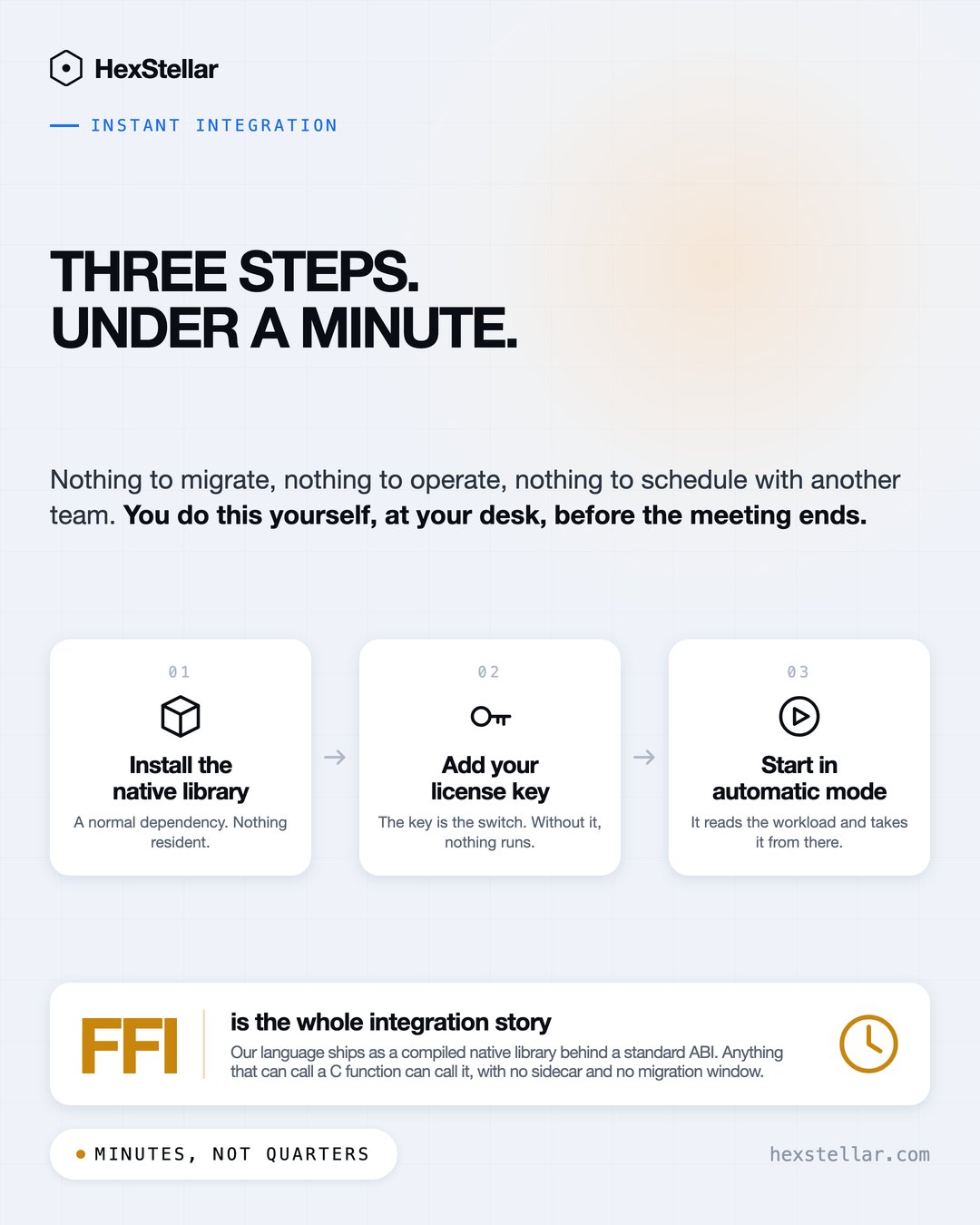
One line for the integrating team. Thousands upon thousands of configuration paths underneath it. The closed native library carries a large tuning surface — hardware generation, memory topology, batch shape, precision, scheduling pressure and parameters that interact at once — and the patent-pending work resolves that surface for qualified hardware and workloads automatically at startup.

That is the whole design: the complexity is real and it is very large. It just is not the integrating team's burden to carry.

  • Thousands of configuration paths, resolved for qualified hardware automatically.
  • Patent-pending work at the core — years of work behind one integration point.
  • A single integration surface — no per-model source work and no public HXS syntax to learn.
  • No hidden dependency chain — zero external dependencies at the native core.
  • Reported outputs verified as identical across every model in the published campaign.
  • Compiled library and verification package shared only through approved Enterprise evaluation under NDA.
Enterprise evaluation pattern
# Available only inside an approved NDA evaluation.
runtime = enterprise.attach(
    workload="qualified-inference",
    verification="required",
)

# Your existing serving stack remains in place.
answer = model.generate(prompts)
Illustrative contract · not a public CLI command · no runtime ships in the public package

Today · Servers

Servers and inference clusters

Search, retrieval, classification and batch work — the high-volume serving paths where the energy bill is largest. The published evaluation path wraps the system that already runs.

Next · Devices

Phones, laptops and on-device models

Here the target is not only speed, but battery and heat: less work reaching the silicon and fully local execution. This is product direction, not public availability today.

Horizon · Silicon

Chips and accelerators

The long-term direction is direct integration into the hardware that runs the workload. These are early-stage conversations, not a currently available product.

We did not build HexStellar to be a “green” language. We built it to be the most correctly engineered language we could. In the published campaigns, less energy, less heat and less hardware stress were the measured consequence of getting the foundation right.

Patent pending · mechanism remains closed
Campaign 1 · energy per card

Five models. One GPU. A controlled measurement.

One NVIDIA H100 80GB running vLLM 0.26.0, layer on versus off at identical load across five independent labs' flagship models. Every percentage in this campaign uses energy per card as its denominator.

Capacity

+167%

109.8 → 293.7 requests/sec at the same latency target.

Energy / card

−17.2–27.4%

Lowest measured reduction: Gemma 3 27B. Highest: Llama 3.3 70B.

Temperature

up to −15°C

62.4°C → 47.4°C on Meta Llama 3.3 70B.

Evidence

RFC 3161

Signed measurement files shared with evaluating companies.

Lab · modelEnergy / cardPeak temperature · off → on
Alibaba · Qwen2.5-72B-Instruct−26.9%60.9 → 47.5 °C
Meta · Llama 3.3 70B−27.4%62.4 → 47.4 °C
DeepSeek · R1-Distill 70B−24.8%61.9 → 49.3 °C
Google · Gemma 3 27B−17.2%52.6 → 43.1 °C
Microsoft · Phi-4 14B−25.5%51.0 → 40.2 °C
Campaign 2 · energy per request

A second campaign, measured on its own terms.

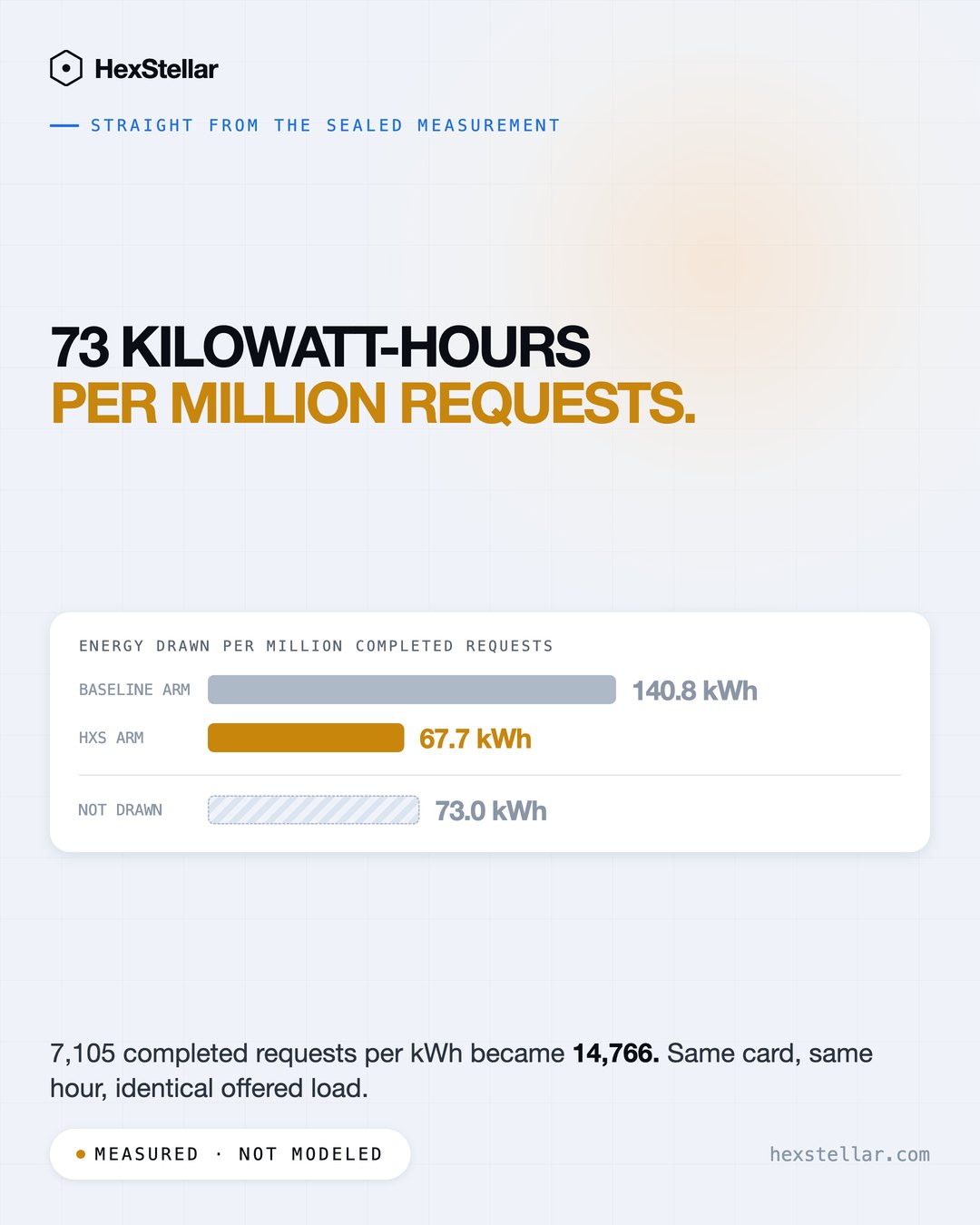
Separate runs on an NVIDIA H100 80GB SXM. These are per-request figures, not per-card figures, so they are not combined with Campaign 1 and are not presented as a revision of it.

Energy / request

−52% to −66%

Large models across this campaign.

Capacity

up to ~2×

Effective requests on the same H100.

Native library path

~13 µs p50

~17 µs p99; not end-to-end generation.

Measured output errors

0

Aggregates signed with Ed25519.

Hardware remained ordinary for the campaign: no special SSD, CXL or AI-optimized flash appliance — a stock NVIDIA H100 and the native library. The signed verification package is available to qualified evaluators under NDA.

The measurement · seven slides

The complete visual story.

The same seven-slide set retained from the original homepage. Swipe, scroll or use the controls.

Less energy, less heat and more capacity on H100 inference
Slide 1 of 7
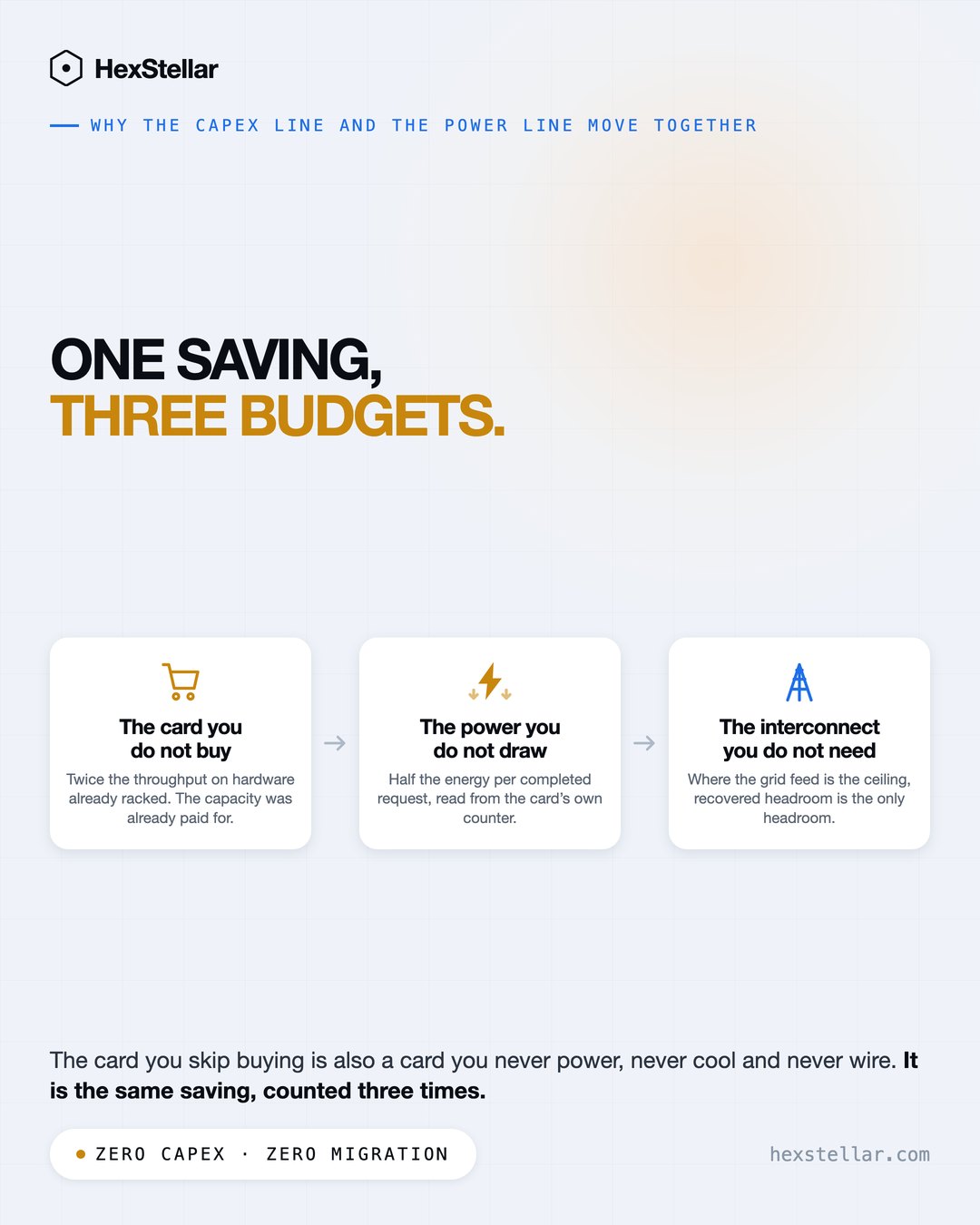
One saving across power, thermal and hardware budgets
Slide 2 of 7
Energy saved per million inference requests
Slide 3 of 7
Native library integration in three steps
Slide 4 of 7
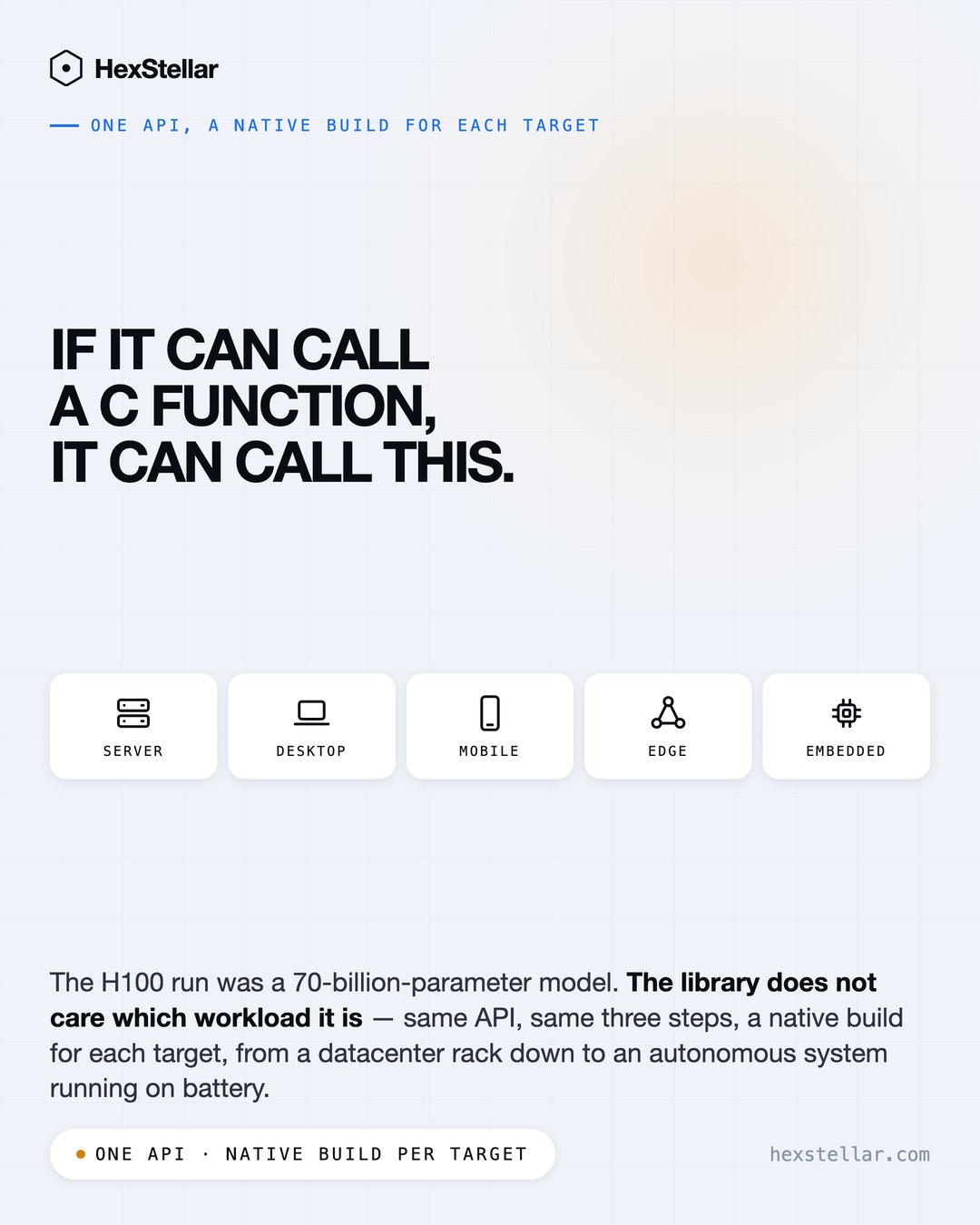
One native API across deployment targets
Slide 5 of 7
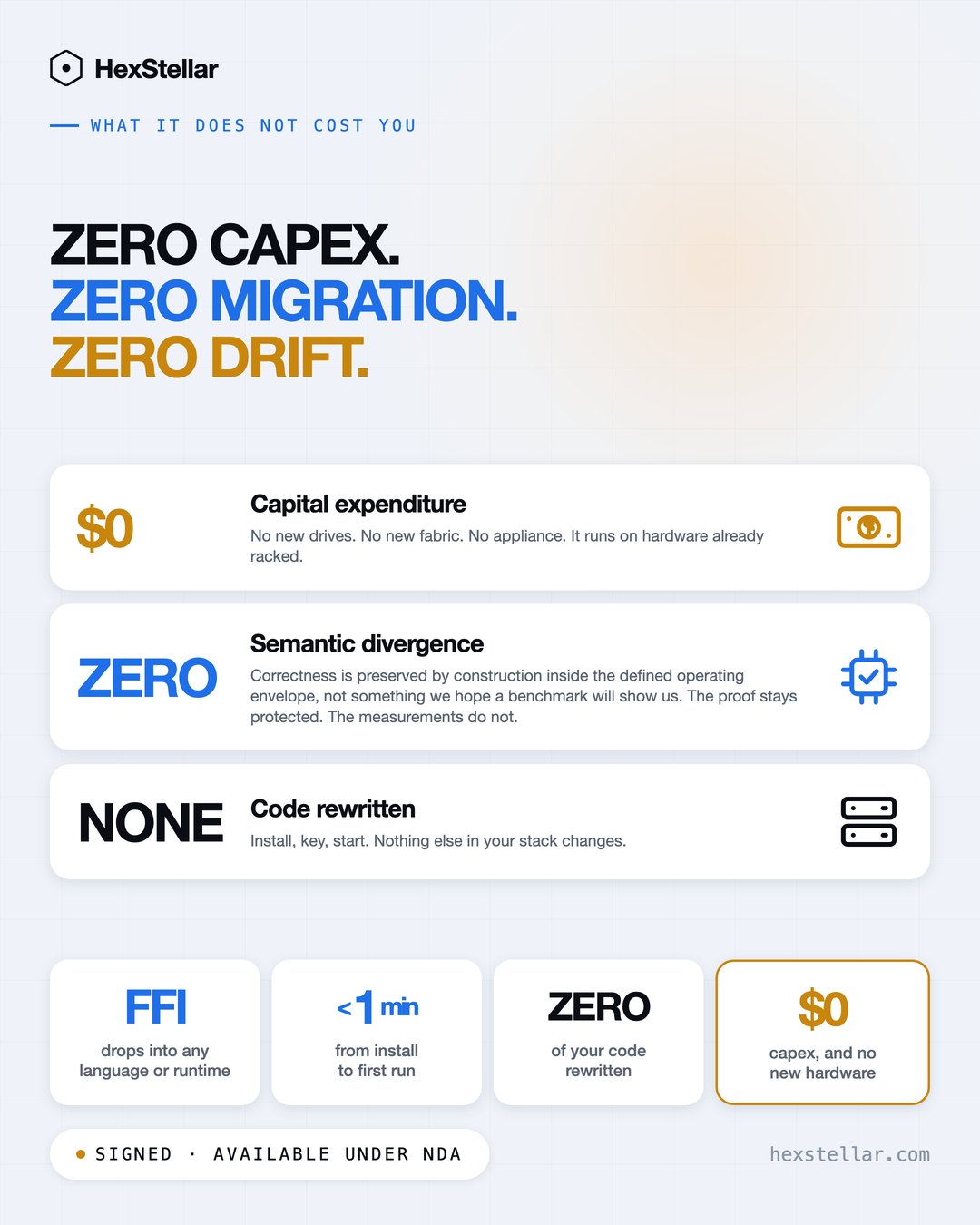
No new hardware, migration or reported-output drift
Slide 6 of 7
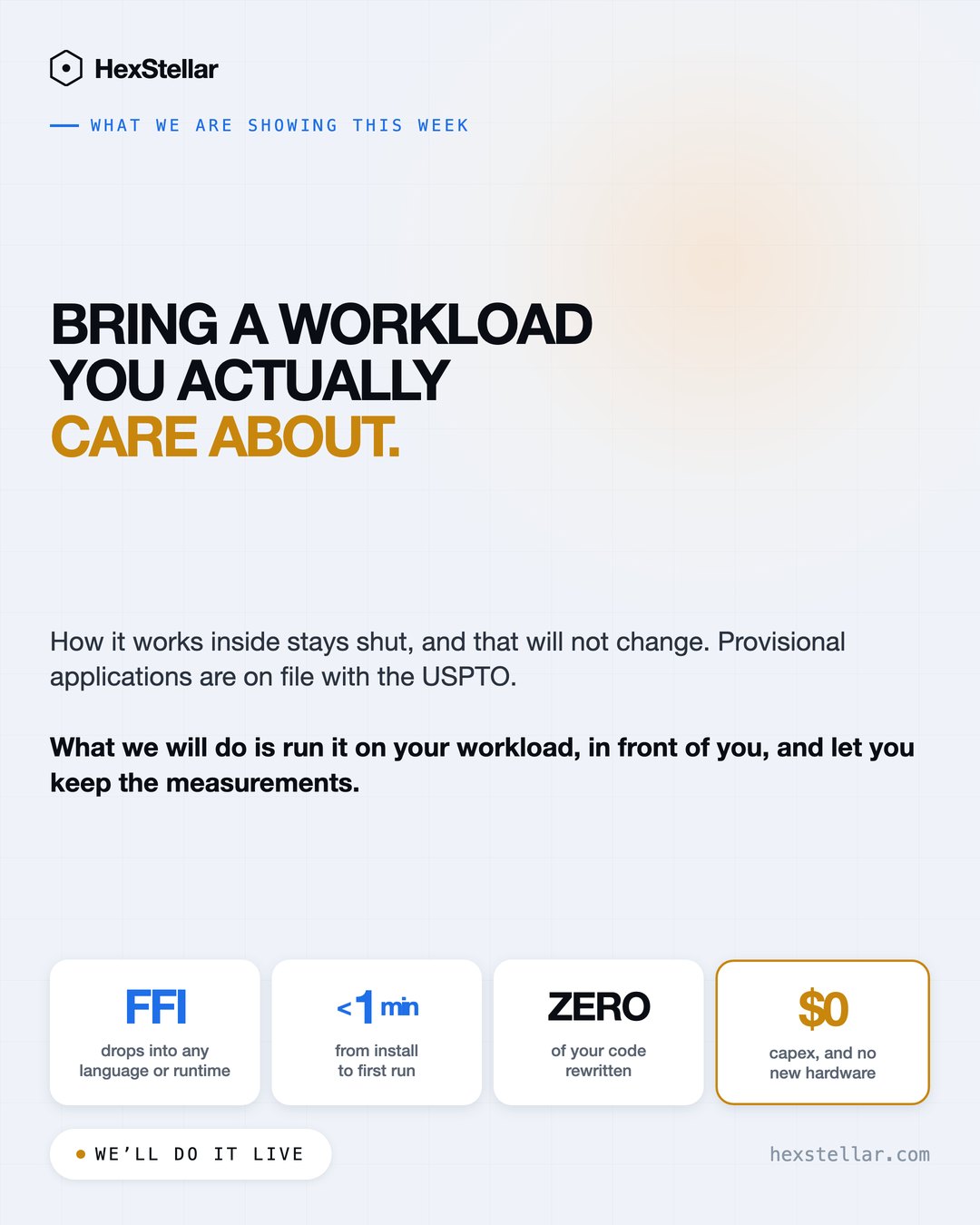
Bring a live workload and measure it
Slide 7 of 7
What comes next

Inference is one front. It is not the only one.

The two published campaigns are language-model workloads because they were completed first. Other fronts are evaluated separately; they become public claims only when their own workload, hardware, denominator, correctness scope and evidence are ready.

Public benchmark class

Combinatorial optimization

Publicly checkable instances on consumer hardware; claim scope follows the receipt and independent verifier.

Routing & logistics

Tours, assignment, scheduling

Traveling-salesman, vehicle-routing, allocation and scheduling shapes.

Selection under constraint

Knapsack and allocation

Choosing the best subset when candidates compete for a shared budget.

Scientific computing

Dense sensor reconstruction

Recovering structure from large noisy detector output, with the operation and assurance stated explicitly.

On-device

Phone and edge silicon

Fully local evaluation direction where battery, heat and privacy matter.

Not named yet

Additional measured work

Kept private until the evidence and publication scope are complete.

What the discovery became

A discovery is not a product. So we built the product too.

Finding the effect was the first year. Turning it into something another engineering team can evaluate without rewriting its stack was the harder half.

01

Patents filed first

The filings came before public disclosure. This site describes results and never the protected method; that order is deliberate. The work is patent pending, with the underlying research documented beyond what appears here.

02

A language of our own

HXS exists because the discovery could not be expressed properly in anything that already existed. Its semantics are the point: a general-purpose language with a different foundation. The syntax and proprietary mechanism are not public.

03

A closed native library

An approved partner does not adopt a new language to evaluate it. The compiled native library links into a serving stack already in production: no model retraining, weight conversion or bespoke hardware. The public CLI 1.0 contains none of that proprietary runtime.

The reason HexStellar leads with integration rather than capability is that the second question every serious engineering team asks is what does this cost me to try. The evaluation answer is deliberately practical: a bounded native integration and a benchmark run on the partner's own qualified workload. HexStellar would rather be evaluated that way than believed on the strength of a chart.

Everything else — the mechanism, the language itself and the internals of the library — stays closed. That is not a decorative marketing posture. The foundation is the protected asset, and the public product explains its inputs, outputs, measured effects, limits and verification without publishing the recipe.

The rules we actually run on

This part matters more than the numbers. Anyone can produce a benchmark. What determines whether it means anything is the discipline around it.

01

Every published number is a measurement

Nothing on this page is promoted as a campaign result by modelling, extrapolating or projecting from a smaller run. Where a figure has a scope — per card or per request — that scope is stated next to it every time.

02

Results are signed and timestamped

Measurement artifacts are hashed, signed with Ed25519 and timestamped against independent authorities. A published number cannot be quietly revised after the fact, including by HexStellar. The verification package is shared with evaluating partners under NDA.

03

The whole campaign stays visible

The published tables retain the smaller measured effects as well as the largest. A campaign is not reduced to the most flattering slice of a series.

04

Nothing is published before it is finished

Work goes public finished — the write-up and signed file held to the same standard as the number beside them. There is no public roadmap of promises standing in for measurement.

05

Partner names remain private

Companies evaluating the Enterprise Runtime are under NDA in both directions. HexStellar will not trade a partner name for credibility on a landing page.

External validation · Trust Carbon

Four external reviews. US$150,000 awarded.

These awards belong to Trust Carbon, the startup whose infrastructure work led Brayon Pieske to the HexStellar discovery.

Winner · top five global

US$100,000

DPI for People and Planet Innovation Challenge

One of five winners selected from 540 startups across 73 countries.

Gates Foundation · BCG · JICA · Co-Develop · CDPI · COP30 Brazil

Awarded 2026

US$50,000

Meta AI Glasses Impact Grants — Accelerator

Field verification of forests with Meta AI glasses in the hands of farmers and local communities.

Meta Platforms

Selected 2026

Fellowship

Halcyon Climate Fellowship

In-person Washington, D.C. and Los Angeles residencies with Deloitte mentorship.

Halcyon

Accepted

Peer reviewed

IFAMA 2026 World Symposium

Trust Carbon’s first academic paper was accepted into the symposium programme.

International Food and Agribusiness Management Association

Brayon Pieske, founder of HexStellar and Trust Carbon Infrastructure
Arlington, Virginia · Washington, D.C. · April 2026
Founder and discoverer

Brayon Pieske

Roughly fifteen years of shipping production software, enough of it close to infrastructure to recognize a cost that did not belong where it was.

He started with software where a failure had someone on the other end of it: a blood donor matching platform connecting donors to hospitals nationwide, a flood alert system used during real emergencies, and field tools that biologists used to track species.

Then came commercial work at a different scale — sales platforms, one of which he exited, and messaging infrastructure running inside data centers, where the constraint stops being the interface and becomes throughput and cost per operation.

That is the instinct this company is built on: the suspicion that a cost is structural rather than inevitable. He built Trust Carbon substantially solo, took it in front of the Gates Foundation, BCG and JICA, and won. HexStellar is what came out of trying to make it cheaper to run.

Founder profile Connect with Brayon Pieske on LinkedIn Read how the discovery happened ↑

Nine months · five rooms

Future of Memory and Storage 2026
Santa Clara, California · 4 August 2026
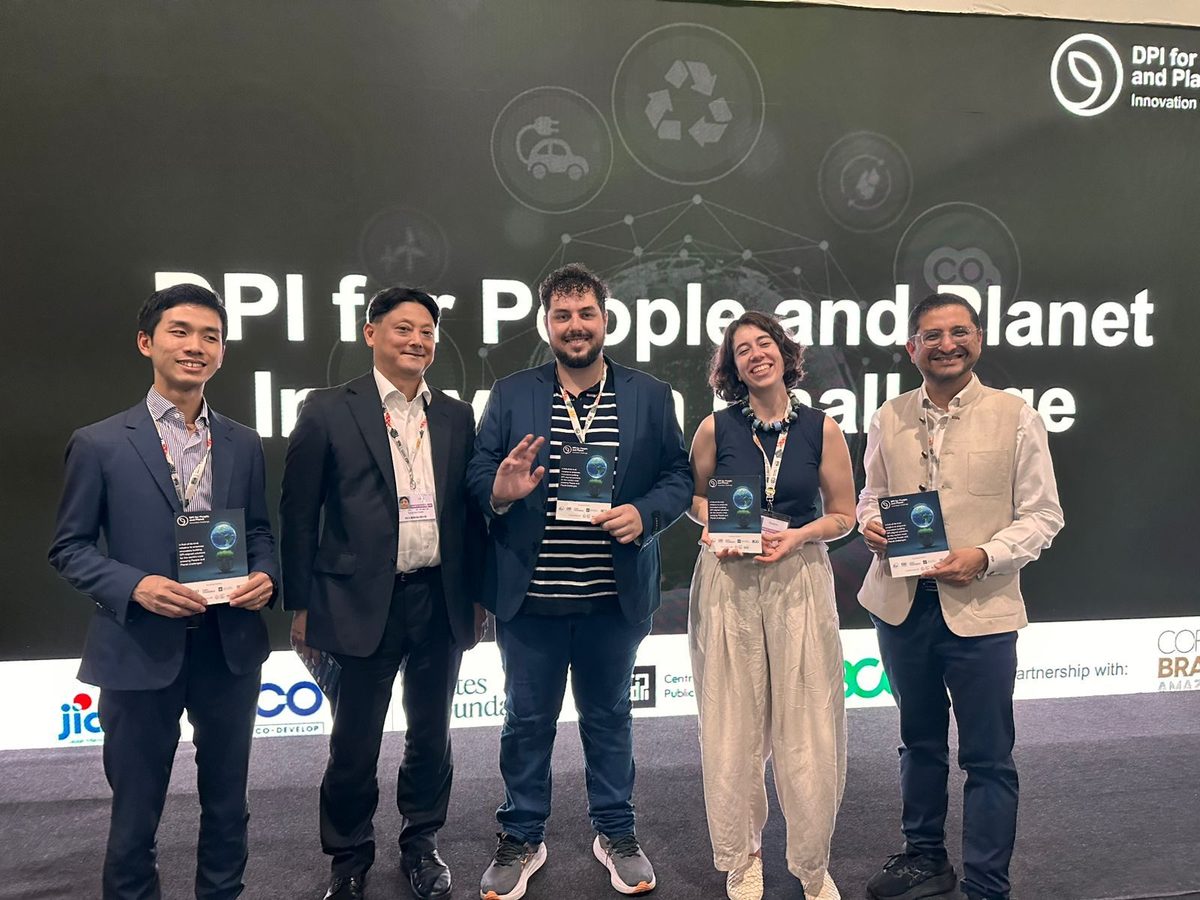
DPI for People and Planet — winners, COP30
Belém, Brazil · November 2025
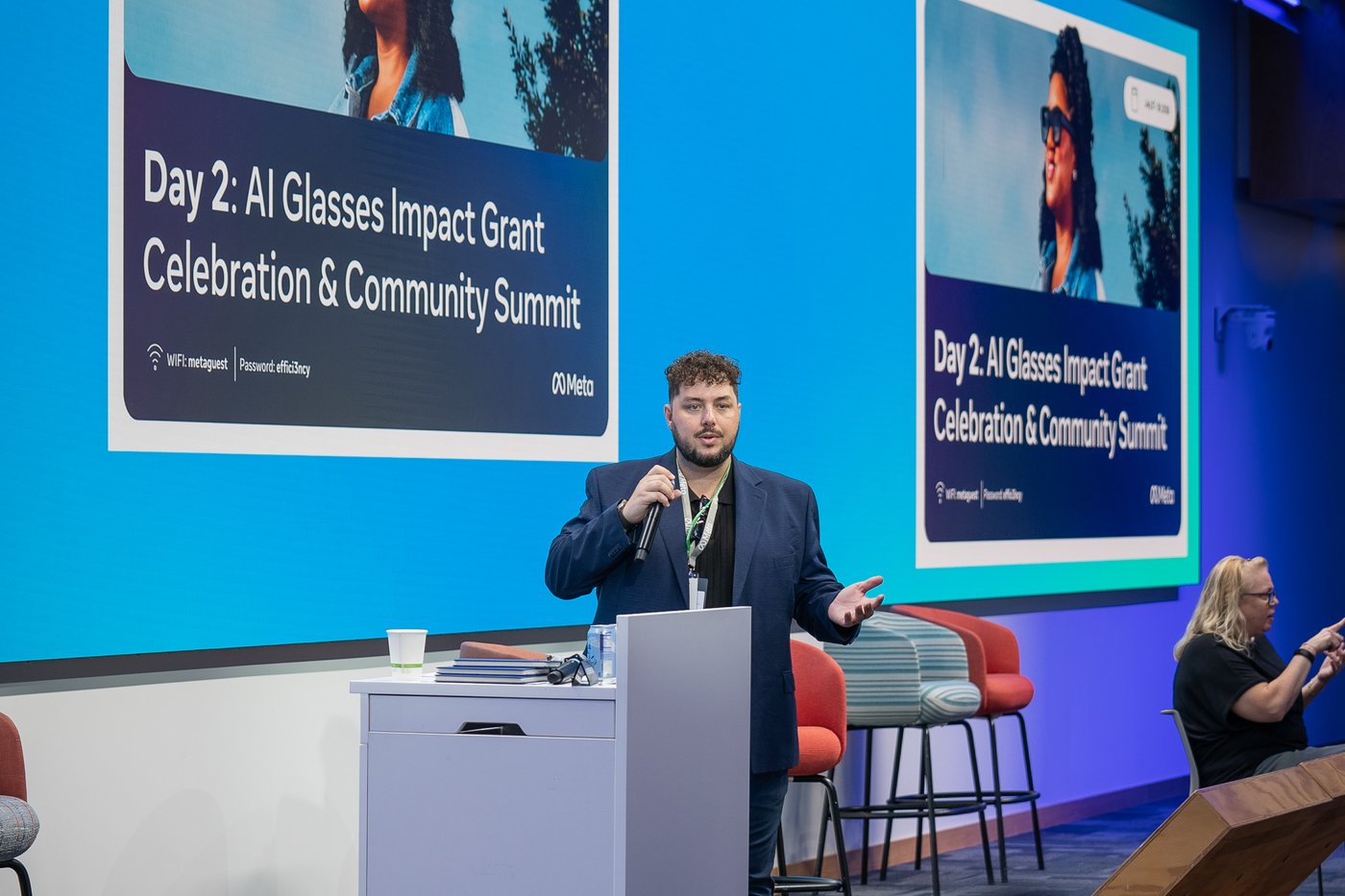
Meta AI Glasses Impact Grant Summit
New York · 29 July 2026
The company behind it Trust Carbon Infrastructure logo

Trust Carbon Infrastructure

The venture Brayon Pieske was building when HexStellar surfaced — and the reason the team knows how to hold an engineering claim to a standard that survives scrutiny.

Digital MRV & verification platform · established 2023

2M+

lines of code across web and mobile

Offline

field application with its own navigation

17

supported languages

4+

methodology families including Verra, Gold Standard, CDM and LuxCS

US$100K

DPI Challenge award

California

Zenith Flow Innovations LLC

Trust Carbon Infrastructure is a methodology-agnostic verification platform for carbon-credit and biodiversity projects, built to work under real field conditions — offline-first data collection from a smartphone, with anti-fraud safeguards including GPS-spoofing detection and cryptographic hashing of every record. It supports major methodologies including Verra, Gold Standard, CDM and LuxCS, in 17 languages.

More than two million lines of code span the web platform and mobile app. The field app runs completely without an internet connection: no third-party APIs, no external services to call, and its own navigation system rather than a hosted map. That was not a preference. The places the platform is designed for may not have a signal, so anything rented from the cloud simply would not run there.

That constraint is also where HexStellar came from. Building a system that had to do everything itself, on whatever hardware was in someone's hand, turned a computational bottleneck into a question worth chasing.

The platform was named one of five global winners of the DPI for People and Planet Innovation Challenge, out of 540 startups from 73 countries — a US$100,000 award judged by the Gates Foundation, BCG and JICA. The same discipline — auditable, reproducible and sealed against drift — shapes how HexStellar holds its benchmark claims.

Trust Carbon Infrastructure is legally operated by Zenith Flow Innovations LLC, a U.S. company based in California.

Visit trustcarbon.org ↗

Researchers & laboratories

Bring the benchmark the field still finds difficult.

Universities, independent researchers and applied laboratories can evaluate Cortex through the public CLI, publish reproducible results, and request a scoped Enterprise Runtime evaluation for qualified workloads. Enterprise materials, artifacts and availability remain subject to direct review and NDA.

Found a missing parameter, a confusing explanation, a failed formulation or a useful product idea? Send the command, error code and a minimal reproduction to [email protected].

A publishable benchmark record

Start fast, preserve provenance, and state only the assurance the evidence earned.

  1. 01

    Install the public client

    Record the HexStellar CLI version and use `pip install hexstellar` in a clean environment.

  2. 02

    Establish the flash baseline

    Run the public example or your adapted formulation with effort `flash` before spending a larger search budget.

  3. 03

    Make the input identifiable

    Publish the input or generator, seed, scale, source licence and SHA-256 whenever redistribution is allowed.

  4. 04

    Report the complete result

    Include effort, elapsed time, compute units, hardware context, receipt and the returned assurance label.

  5. 05

    Verify independently

    Recompute the witness, objective, constraints or domain property; never promote heuristic or best-known into certified.

Get in touch

Bring a workload you actually care about.

For API access, create an account and receive your key. For Enterprise runtime evaluation, licensing, signed measurement files or the verification package, contact the team directly. Enterprise material is shared under NDA.

Enterprise and licensing
[email protected]
CLI support and feedback
[email protected]
Press and media
[email protected]
Availability
Cortex API and CLI registration are public. Customer deployment of the Enterprise Low-Energy Runtime requires a license issued directly by HexStellar under NDA.

© 2026 HexStellar · Zenith Flow Innovations LLC · California, USA · Patent pending